DHI
Implanter-pen precision where the hairline matters most.
In DHI, each graft is loaded into a spring-loaded implanter pen and placed in a single motion — no pre-opened channel. That gives the surgeon the finest possible control of angle, depth and direction, which is exactly what the visible front edge of a hairline demands.
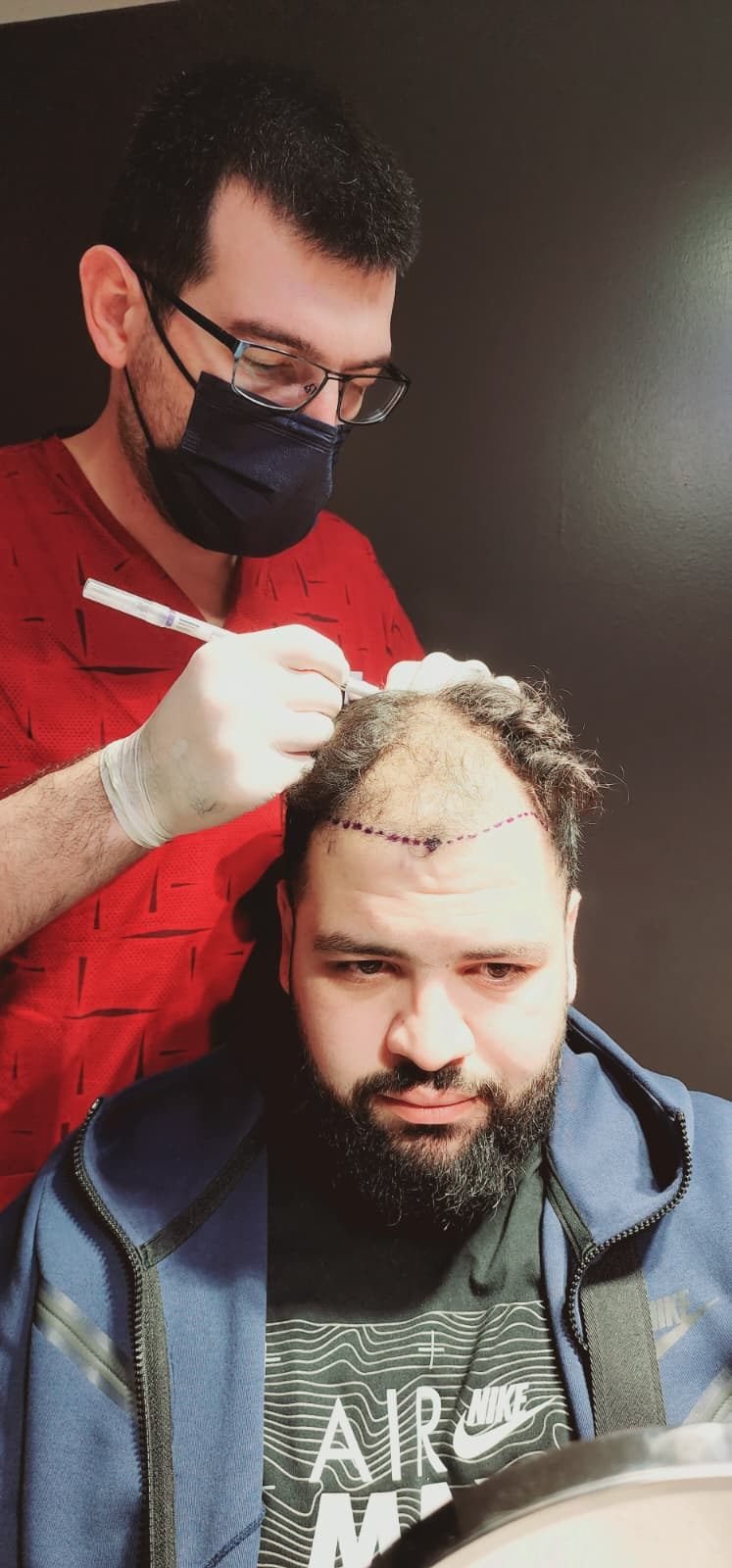
The technique, without the brochure gloss
DHI — direct hair implantation — uses a Choi implanter pen: a fine hollow needle that holds one graft, pierces the skin, and deposits the graft in the same movement. Channel opening and placement collapse into one controlled act.
The practical gains are angle and depth control at the hairline edge, denser packing in small zones, and less time for grafts outside the body. It also makes the unshaven variant possible.
Honesty note: DHI is not “the newer, better FUE” — it is a placement method with real advantages in the frontal zone and real disadvantages for large areas, where it is slower and more expensive per graft with no visible benefit at crown distance.
Step by step
- 1
Design and anaesthetic
The hairline is agreed in the mirror, the donor area shaved in a concealable band or fully, and local anaesthetic administered.
- 2
Extraction
Identical to FUE: grafts removed individually from the donor area and sorted by hair count.
- 3
Loading
Each graft is loaded into the implanter pen by a technician — a rhythm of load, hand over, place that continues for hours.
- 4
Direct placement
The pen places each graft at its exact angle and depth in one motion, singles defining the leading edge of the hairline.
Who it suits
- Frontal hairline and temple work, where angle decides everything
- Moderate areas up to ~3,000 grafts
- Patients wanting the unshaven option
- Density-focused packing in defined zones
Who it doesn't
- Very large areas — a Norwood 5–6 rebuild is usually better served by Sapphire FUE or a combination
- Budget-led decisions: you pay 15–20% more for a difference that is invisible outside the frontal zone
The honest limitation
DHI’s per-session ceiling is lower and its price higher. For big areas we often recommend Sapphire FUE for the bulk and DHI for the leading edge — or simply Sapphire FUE alone. If a clinic recommends DHI for everything regardless of your pattern, they are selling their margin, not your outcome.
What the weeks actually look like
- 1Days 1–3
Redness and pinpoint crusting; first wash on day 3.
- 2Days 4–14
Crusts clear; the unshaven variant is socially invisible earlier than the shaved one.
- 3Week 3–4
Shock loss — the transplanted hairs shed before regrowing. Normal.
- 4Months 4–12
Growth, thickening, and the month-12 verdict photo.
See real healing-stage photos in patient results — including the stages other galleries crop out.
All-inclusive, from €3,200
Up to ~3,000 grafts, 2 hotel nights, transfers, interpreter and 12-month aftercare included.
Included at this price
- Surgery with all hospital and theatre fees
- Hotel, breakfast and every transfer
- Interpreter and named coordinator
- Aftercare kit and 12 months of photo reviews
Asked about DHI
Neither, universally. DHI wins at the hairline edge and for unshaven work; Sapphire FUE wins on volume, session size and value. The honest answer depends on your pattern — which is what the free assessment is for.
In small, defined zones, yes — the pen allows tighter packing. Across a whole head the limiting factor is your donor supply, not the tool. No instrument creates grafts you don’t have.
It is slower — each graft is individually loaded and placed — so the same team treats fewer grafts per day. You are paying for placement time, which is real, not for a superior technology, which is marketing.
Not sure this is your technique? Good.
Choosing a technique from a website is guessing. Send three photos and get a recommendation with the reasoning shown — including when the cheaper option is the right one.